
- 3 replies
- 1,084 views
- Add Reply
- 2 replies
- 913 views
- Add Reply
- 5 replies
- 992 views
- Add Reply
- 3 replies
- 1,408 views
- Add Reply
- 3 replies
- 1,067 views
- Add Reply
- 0 replies
- 582 views
- Add Reply
- 3 replies
- 1,611 views
- Add Reply
- 4 replies
- 1,563 views
- Add Reply
- 18 replies
- 3,854 views
- Add Reply
- 3 replies
- 13,095 views
- Add Reply
- 2 replies
- 1,712 views
- Add Reply
- 5 replies
- 1,495 views
- Add Reply
- 1 reply
- 1,466 views
- Add Reply
- 5 replies
- 1,307 views
- Add Reply
- 2 replies
- 1,093 views
- Add Reply
- 7 replies
- 2,459 views
- Add Reply
- 3 replies
- 1,029 views
- Add Reply
- 3 replies
- 1,019 views
- Add Reply
- 1 reply
- 4,004 views
- Add Reply
- 1 reply
- 1,002 views
- Add Reply
Secure 2.0 Headaches - Annuities and defined contribution plans.

Notice of Adverse Claim-Interest.pdf Notice of Adverse Claim- Interest Cover Letter (2).pdf
Excludable or Benefiting

A DBP requires 1000 hours for a year of credited service. However, final average earnings (FAE) is determined monthly through end of employment. Therefore, someone who terminated and worked less than 501 hours in a year could nonetheless experience an increase in their accrued benefit by virtue of an increase in FAE despite not earning credited service.
Are we able to statutorily exclude these participants for 410(b) testing or are they considered benefiting or could benefit (i.e., term < 501 hours NOT being the reason they fail to benefit)? I know we would have to include or exclude all such participants on whichever basis whether they experienced a benefit increase in actuality or not.
I did a little digging but couldn't find anything right away so am turning to very small colleagues in the forum. Thank you in advance.
Am I included in 2023 testing and gateway

CB/DC combo
401k with NESH at 3%
Terminated on 12/22/2022 but received the final paycheck in 2023, last payroll of 2022. No hours worked in 2023.
Do you agree for 2023
Need 3% NESH
Need 2023 gateway
Is H-1B Status a nonresident alien

What would an H-1B employee need to supply to the employer to confirm they are an nonresident alien? Plan excludes nonresident aliens and employee is asking to join.
Tax on cash Distribution

Participant under 591/2 wants her $6500 cash from a profit sharing plan.
How much must be withheld by the plan administrator (is it still 20%)
Is the withheld amount sent to the IRS with form 945?
Merge Plans Mid Year with QACA and Enhanced SH Formulas

One of our clients wants to merge a recent acquisition's Plan (Plan B) into their own Plan. Plan B has an enhanced SH Match formula. Plan A's formula is the QACA auto enroll SH Match. Are there any considerations for attempting to do this as of 07/01/24 or best to wait until 01/01/2025? That was my first response but upper management would prefer to do it sooner.
Eligibility Question - Consecutive Months of Service and YOS

We use FIS IDP pre-approved plan documents and have submitted the question to them. However, I wanted to post on here as well to see if anyone may know.
The plan document uses failsafe YOS language when we enter eligibility that's less than one year and includes hours. See language below for the plan in question:
(a) Eligibility. Any Eligible Employee who has completed 167 Hours of Service within 2 consecutive months from the initial date of employment and has attained age 21 shall be eligible to participate hereunder as of the date such Employee has satisfied such requirements. Notwithstanding the foregoing, any Employee who has completed a One-Year of Service shall be deemed to have met the service requirement.
Plan Entry Dates are 1st of the month.
Our understanding of the eligibility above is that if an employee does not complete 167 hours in 2 their first two consecutive months of employment. They have to complete 1000 hours in 12 months.
For example, if an employee was hired January 23, 2023, on March 23rd they completed 2 months of service and on April 1st they would enter the plan as long as they completed 167 hours within the 2 months.
However, what if the person only complete 80 hours in the 2 consecutive months. They are not eligible to enter the plan on April 1st, correct? They will now need to complete a year of service which is 1000 hour within 12 months?
Let's assume they completed 1000 hours by September 15, 2023. Do you agree that they would be eligible to enter the plan on that date? Some of the confusion here that a few of us believe that the year of service means that they have to complete 12 months of service (January 23, 2023, to January 23, 2024, and the 1000 hours) However, I disagree i believe a YOS only means 1000 hours in this case.
ASG Management Group

Do the ASG management group rules apply to businesses that are service businesses? For example, would it apply to car dealerships? Or so the recipient business who receives the services from a management company have to be a service based company?
Terminated Pension now with F&G showing incorrect "Early Retirement Date."

I have another strange one, but this time I made sure to make sure that I have this well documented before asking questions.
Client left employer a few years ago, after age 55. She had a pension benefit (Defined Benefit Plan) that was from a frozen plan. In 2019, the pension offered a lump sum buyout. They opted to continue to delay starting the pension. In June of 2023, the pension terminated and sent out elections for, again, lump sum, start income now, or delay. Again, they opted to delay. Their plan was to start the pension now, at 62 years old. Normal retirement age is 65. Every communication at every point indicated that they were eligible for Early Retirement, though, as of both the 2019 documents and the 2023 documents. We have it in writing: "You have met the requirements for Early Retirement as described in the Plan. You are eligible to receive an early retirement benefit at any time between now and your normal retirement date reduced under the terms of the plan."
F&G "issued a group annuity contract" for the pension in December 2023. F&G is now stating that they cannot start their benefit until 2027, when they hit 65 years old. I was certain that the person they spoke with must just have been mistaken, so we logged in, and sure enough: the site shows February 2027 as both the "Early Retirement Date" and the "Normal Retirement Age."
This is not something they could have changed, correct?
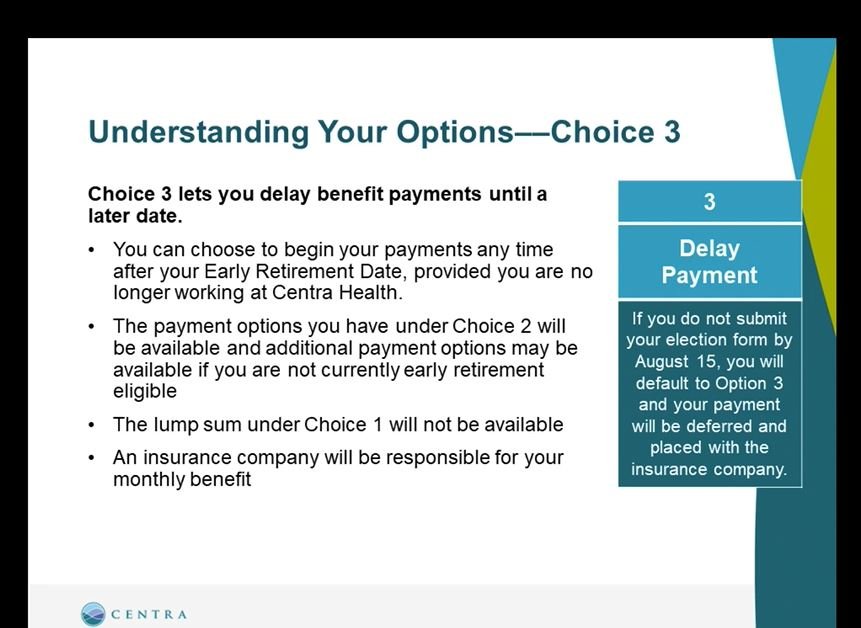
This is a screen shot from a video that the sponsor released regarding the plan termination.
What recourse does the client have in this situation?
Unfortunately, I don't have access to the actual plan documents. The annuity certificate has apparently not been issued yet (or at least isn't available on the site yet) and the previous pension service center does not have any documents available. But we do have the election notices from both 2019 and 2023 clearly stating that they are eligible for early retirement.
No QDRO filed after divorce - can ex go after new assets/new spouse's assets?

I was married for 17 years and divorced in 2010. We were supposed to file a QDRO, but none was done because my ex couldn't come up with her half of the costs. We had no assets, and the QDRO was for my retirement.
I'm planning on remarrying and I wanted to know: after I remarry, can my ex file a QDRO and try to go after assets acquired after the divorce? Could she go after my new spouse's assets? Or would she be limited to the assets at the time of the divorce?
Trying to get some peace of mind since I plan on remarrying soon. I'm starting the process for a QDRO now.
Thanks
Universal availability and LTPT rules

Here’s my understanding:
SECURE Act 2.0 amended IRC section 403(b)(12(A) to make the universal availability rule subject to new ERISA Section 202(c). This means that 403(b) plans can still exclude students and employees who normally work 20 hours per week. But, once an employee who is expected to work less than 20 hours per week meets the definition of LTPT, that employee must be permitted to make salary deferral contributions under the Plan.
Because the “student” employee exclusion is not based on service, that classification is not impacted by the LTPT rules.
The issue where further guidance is needed is how does IRC Section 410(b)(4) impact this. Under IRC Section 410(b)(4), the “20 hours per week” exclusion cannot be used unless all employees within that exclusion category are excluded. Does this mean that if one “20 hours per week” employee later meets the LTPT requirements, then all “20 hours per week” employees must be covered? I think it probably does.
I do not think 403(b) plan sponsors that are excluding “20 hours per week” employees should necessarily amend their plan to remove the “20 hours per week” exclusion. Here’s why: Employers are not required to make non-elective or matching contributions on behalf of participants who are eligible to participate solely by reason of the LTPT rules. If the plan sponsor removes the “20 hours per week” exclusion, then part-time employees become eligible without regard to the LTPT rules. My concern is that the non-discrimination (and top-heavy) rules would now apply to this otherwise excludable classification.
Agree, disagree? Thanks.
True Up Contributions

If a participant didn't defer the maximum they could in one plan year, is it allowable to allow them to make a sort of true up contribution and give them the opportunity to make additional contributions for the prior year?
Auto enrollment for plans that join a PEP or MEP which was established after 12/29/2022

In a recent webcast on the "IRS grab bag" regarding automatic enrollment, it was noted that for plans joining a PEP or MEP - "remember - the determination is based on the participating employer and not the MEP/PEP original effective date". In this case, I believe that if a plan with an original effective date of 1/1/2020 joins a PEP on 1/1/2023, they are "grandfathered" and would not be subject to automatic enrollment. The webcast did not address when the PEP was established.
However, in a recordkeeper's summary, it is noted "A pre-enactment single employer plan that merges into a MEP established on or after December 29, 2022 (a post-enactment MEP) will lose its pre-enactment / grandfathered status."
These seem to be contradictions. When I look through Notice 2024-2, I do not find any references to PEPs or MEPs. Is anyone aware of a site that addresses the PEP / MEP establishment date trumps a plan's original effective date?
Sole Prop, PS Plan, Cont Calculation

I just need some clarification. I know how to do the calculation. The profit figure to use is line 7 of the Schedule C?
Line 7 profit
multiply by 1402(a)(12) deduction (.9235)
calculate and deduct FICA
calculate and deduct MED
Back into plan contribution
Add it all up and the result is Line 7
Right? I want to explain it succinctly to the financial advisor.
pro rating the SSTWB integration limit in a short year (plan term)

I'm doing a final PS allocation for a calendar year plan that was terminated 9/15/23. That was the final pay date before they were purchased, and all payroll stopped then, and the purchase agreement required that the plan be terminated as of that date. I couldn't convince them to let the plan run until 12/31/23.
The PS formula is integrated at 80% SSTWB + $1. So for 2023, if it was a full calendar year, that would be $128,161. x8.5 /12 = $90,780.71 (or something like that, depending on when you add the extra dollar). The question is what to do with the integration level. This is below 80% of the annual limit, so do I have to use 4.3? Or do I get to still use 5.4% because it's 80%+ of the applicable limit once the pro rating is considered? My software gives me an error on the latter because 56.667% of the TWB is not at least 80%, but I know to always double-check things in tricky situations...
NQDC Church Plan - Eligibility and Vesting

Can/must a church having a 501(c)(3) determination and offering a nonqualified deferred compensation plan limit eligibility to a "top-hat" group? Also, as I understand 457(f) doesn't apply in the case of a church employer, can plan accounts avoid current taxation upon vesting, as usually occurs with other tax-exempt organization nonqualified plans?
Contribution classification correction

I have an issue where a 2023 contribution that was intended to be made as an employee contribution was erroneously made as an employer contribution (due to a new employee being unaware of the correct forms to use). Can this contribution be recharacterized as an employee contribution? If so, would we use ECPRS or VCP?
Thanks!
Coverage and Safe Harbor Match

I have two 401(k) Plans that are a controlled group, and they fail both 410(b) and average benefits tested separately. I'm testing them together, but the issue is one plan has a basic SHM and the other plan has an enhanced safe harbor match of 100% up to 4%. I believe that both plans should have the same match formula but I'm having difficulty putting my eyes on any articles or regs saying this to confirm what I believe. I read something recently where it mentions if there's a 3% safe harbor non-elective then both plans should have the same formula and the plan without the 3% would have to give the 3% to the eligible participants. Has anyone else ran into this issue with safe harbor match plans that are required to be aggregated for testing? Thank you so much!
missed deferral opportunity

I have a sponsor that changed payroll systems in 2021. As a result of that change , overtime was not calculated correctly in 2021 through 2023 for a group of participants. Sponsor self-discovered the error in late 2023 and paid this group of employees back pay on a separate 10/20/2023 payroll. The plan is a 401(k) deferral only plan covering only collectively bargained employees. The plan does not include an automatic contribution arrangement.
According to their plan document, the back pay is eligible compensation/allocation pay. The sponsor did not take elective deferrals for this separate payroll. We didn't learn about this issue until after 1/20/2024. No notice has been provided to the affected participants.
I'm trying to figure out if there is a way to turn this into a notice only or zero QNEC correction. My conservative view is that correct deferrals began with the payroll following 10/20/2023, which would have started the 45 day clock for a notice only correction.
Thoughts?
Safe harbor nonelective plan - mid year amendment to exclude bonuses

Assuming the SH notice is a "maybe not" notice, then such an amendment has the effect of reducing the safe harbor 3% (in this case) contribution. This is permissible under the requirements outlined in 1.401(k)-3(g)(ii), and will take the plan out of safe harbor status for 2024, requiring ADP test for whole year, etc., etc. - all requirements as outlined in the regulation.
Anyone disagree with this outcome?
Featured Jobs
TriStar Pension Consulting
(Remote)
Senior Compliance Analyst 401(k) Plan Administration
MVP Plan Administrators, Inc.
(Remote)
Anchor 3(16) Fiduciary Solutions LLC
(Remote / Wexford PA)
The Pension Design Group
(Remote / Columbus OH / Hybrid)
MAP Retirement
(Remote)
MAP Retirement
(Remote)BLG PLLC
(Remote)
Client Service Executive: Employee Benefits Consulting
Global Employee Benefits Consulting Firm
(Atlanta GA / AL / AR / CT / DC / DE / FL / KY / LA / MA / MD / ME / MI / MS / NC / NH / NJ / NY / OH / PA / RI / SC / TN / VA / VT / WV / Hybrid)Pentegra
(Remote / Putnam Valley NY)
The Pension Design Group
(Remote / Columbus OH / Hybrid)Vice President, Implementation & New Business
PCS Retirement
(Remote)